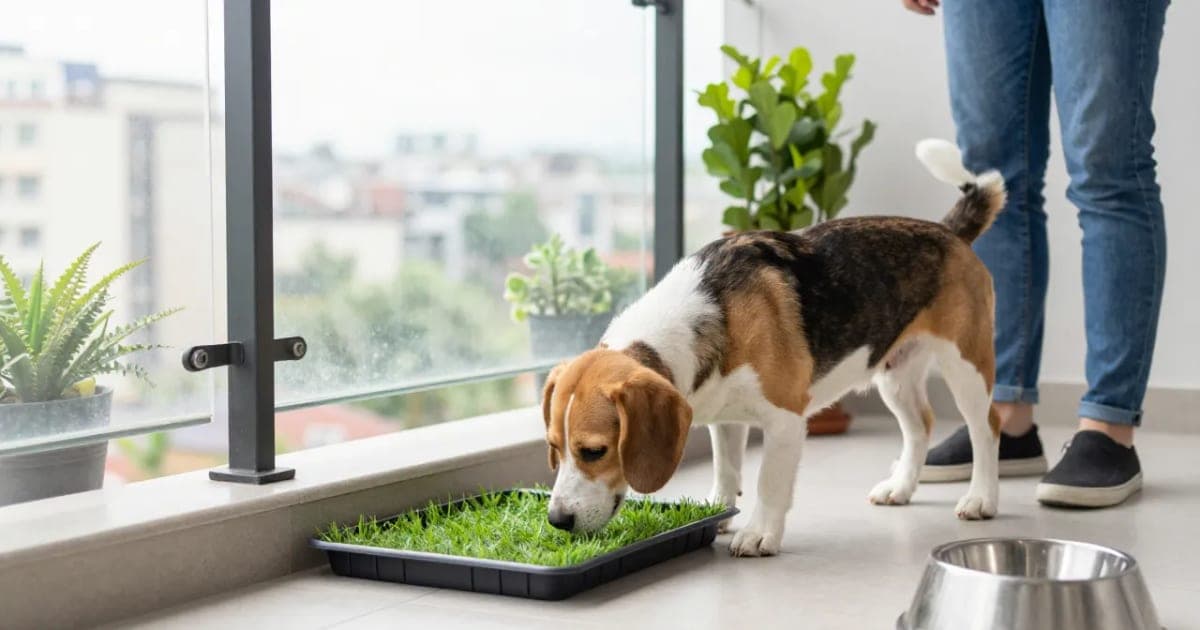
In an apartment, the balcony can look like the obvious answer when your dog needs to go and the elevator, the stairs and the nearest patch of grass are a long way off. Sometimes it is a reasonable backup. But a balcony potty comes with real limits: dogs need time outside, balconies get hot, railings aren't always dog-proof, and urine that drips onto the balcony below is a quick way to fall out with your neighbors.
This guide covers when a balcony potty makes sense, how to set one up safely, how to teach your dog to use it, how to keep the smell down, and which changes in your dog's peeing habits mean a trip to the vet.
Quick answer: use the balcony only as a backup toilet, never as your dog's only outdoor access, and never leave your dog out there alone. Put a pad or grass tray inside something with edges in one corner so nothing drips to the balcony below, check that your dog can't get through or over the railing, and avoid it in hot weather. Teach it like any potty spot, clean up daily, and see your vet if a trained dog suddenly pees more often or has accidents.
Should your balcony be your dog's toilet?
The American Kennel Club's guide to dog-friendly balconies suggests a pee pad in a balcony corner as one option, but it is clear about the limits. The AKC says the balcony shouldn't become your dog's regular toilet and should never be your dog's only access to the outside world.
That leaves a few situations where a balcony spot genuinely helps:
- a young puppy that can't hold it for the trip downstairs yet;
- a senior dog or a dog recovering from surgery or an injury, when your vet has advised limiting stairs;
- late at night, during a storm, or when you are unwell, as an occasional fallback.
It's not a replacement for walks. Even adult dogs need regular chances to go: Ohio State's Indoor Pet Initiative suggests giving an adult dog an opportunity to go out about every four hours when possible, and walks also give your dog exercise and new smells that a balcony can't offer.
Balcony safety checklist
Before you put a potty spot outside, check the balcony itself.
- Railings. The AKC advises against letting your dog on a balcony if they can jump over the railing or squeeze through the bars. Small dogs and puppies can fit through narrower gaps than you might expect; a clear panel or mesh fixed to the inside of the railing may close them, if your lease or building rules allow it.
- Never unsupervised. Never leave your dog alone on the balcony, even briefly; the AKC is explicit on this. DoveLewis, an emergency veterinary hospital, also advises watching pets at all times on balconies and notes that dogs that fall often suffer worse injuries than cats. We found little published data on dogs falling from balconies, so treat this as a reason for caution rather than a statistic.
- Heat. Balconies can turn into sun traps, and the AKC warns that dogs can easily overheat, especially in summer. VCA Animal Hospitals describes heatstroke as a medical emergency, lists being left outside without shade or water on a hot day among its causes, and notes that flat-faced breeds are at higher risk. The ASPCA warns about hot surfaces and advises keeping pets indoors when it's extremely hot.
- Nothing to climb. Move chairs, planters and storage boxes away from the railing so your dog can't use them as a step.
- Footing. Check that the floor isn't slippery when wet and doesn't get too hot for paws in the sun.
If you can't make the balcony safe, an indoor pad near the door is usually the safer backup.
Balcony potty options compared
| Option | Works well for | Watch out for |
|---|---|---|
| Pee pad in a tray, in a corner | Puppies, occasional use | Can blow away or leak at the edges; pads are single-use waste |
| Tray lined with artificial grass | Dogs used to going on grass | Needs regular rinsing and drying so smell doesn't build up |
| Tray with real grass | Dogs that strongly prefer grass | Needs replacing; urine burns grass (see below) |
| Washable pads on a tray | Lower waste | Must be washed often; keep spares |
| No balcony spot, indoor pad by the door | Unsafe balconies, very hot weather | Takes space indoors; move it gradually as training progresses |
Whatever you choose, keep it inside something with edges, such as a tray. The AKC's advice is to keep waste contained rather than letting it fall onto the balcony below. If your balcony floor drains to the outside or to the unit below, a tray with raised sides is the safer choice.
For pads, our guide to biodegradable puppy pads for apartment training compares lower-waste options.
Teaching your dog to use the balcony spot
A balcony potty is taught the same way as any potty spot. The AKC's puppy potty training guide recommends always taking your dog to the same spot, and the AKC's balcony guide suggests using your potty cue once you're there.
- Go at the right times. Take your dog to the spot when they wake up, after play and soon after meals; the AKC suggests within 5 to 30 minutes of eating for puppies. Humane World for Animals adds after drinking, and suggests taking puppies out at least every two hours.
- Know your puppy's limits. Humane World for Animals gives a rough guide of about one hour for every month of age for how long a puppy can hold it.
- Reward straight away. Humane World for Animals advises praising or giving a treat immediately after your dog goes in the right place.
- Never punish accidents. Both Humane World for Animals and the RSPCA say not to punish a dog for an accident. Clean it up and go back to the routine.
Dogs develop preferences for the surface they go on, as veterinary behaviorist Karen Overall explains, so changes between surfaces take patience. If you're moving a dog from an indoor pad to the balcony, the AKC's potty pad guide suggests moving the pad toward the door in small steps, and making it smaller over time, rather than moving it suddenly while your dog is still learning. A similar step-by-step approach may help later, when you want your dog to go outside instead of on the balcony. The RSPCA notes that adult dogs go through the same stages as puppies, though it may take longer.
Keeping the smell down and the neighbors happy
Smell and drips are the two things neighbors notice.
- Contain it. Use a tray with edges and check after each use that nothing has leaked onto the balcony floor or through drainage gaps.
- Clean up every day. Remove solid waste right away and change or rinse pads and grass trays daily. The AKC's potty pad guide advises cleaning accidents with an odor-destroying cleaner, and Humane World for Animals notes that removing scents helps prevent repeat accidents in the same place.
- Rinse and dry trays. Artificial grass and trays need rinsing and full drying so urine doesn't build up underneath.
- Real grass. Penn State Extension explains that dog urine burns grass because of the nitrogen in it, and that watering the spot after your dog pees is the only proven way to limit the damage. It advises against changing your dog's diet to try to solve it. On a balcony, only water a grass tray if the tray collects the water rather than draining it onto the floor or the unit below.
- Hygiene. The CDC advises washing your hands after handling dogs and their supplies, and always picking up dog poop and disposing of it properly. Wear gloves when you handle used pads or rinse a tray; the CDC notes that leptospirosis can spread through the urine of infected animals.
- Check the rules. Leases and condo bylaws may limit pets on balconies, and in some places odor or runoff that affects neighbors could be treated as a nuisance. Check the rules that apply to you before you set anything up, and if a neighbor complains, it's usually easier to fix the drip or the smell than to argue about it.
When accidents mean a vet visit
If a dog that was reliably trained starts peeing more often, in small amounts, or in the wrong places, the cause may be medical rather than a training problem. The Merck Veterinary Manual lists frequent urination, painful urination, and urinating in inappropriate places as signs of a urinary infection, and says a urine sample is needed to diagnose it. Cornell's Riney Canine Health Center adds frequent small amounts and accidents in the house. Ohio State notes that some medical conditions make an adult dog need to pee more often.
See your vet if you notice:
- peeing much more often than usual, or only small amounts at a time;
- seeming to be in pain while peeing;
- accidents in a dog that was fully house-trained.
FAQ
Is it okay to let my dog pee on the balcony?
As an occasional backup, it can be, if the balcony is safe and waste is contained. The AKC says the balcony shouldn't become your dog's regular toilet or their only access to the outdoors.
How do I stop my dog's pee from dripping onto the balcony below?
Use a tray with raised edges or a pad inside a tray, place it away from drains and gaps, and check the floor after each use. The AKC advises containing waste rather than letting it fall to the balcony below.
How do I get rid of dog pee smell on a balcony?
Clean up daily, rinse and fully dry trays and artificial grass, and use an odor-destroying cleaner on any spills, as the AKC advises. Check that urine isn't collecting under the tray or in drainage gaps.
Can I leave my dog on the balcony while I'm out?
No. The AKC says never to leave your dog unattended on the balcony, and balconies can get dangerously hot.
How do I train my dog to use a balcony potty?
Take them to the same spot at regular times (after waking, play and meals), use a cue, and reward immediately. If they're used to a different surface, change it gradually.
Why has my house-trained dog started having accidents?
It can be a medical problem such as a urinary infection, especially if they're peeing more often or in small amounts. See your vet, who will usually need a urine sample.
Related reading: biodegradable puppy pads for apartment training, our guide to what to do with dog poop in an apartment and our eco-friendly, pet-safe cleaning guide.
Part of our Eco-Friendly Dog Care guide — the complete Practical Eco Pet hub for sustainable dog nutrition, health, and home gear.